

In 2026, the automotive landscape has fundamentally shifted. Electric Vehicles (EVs) are no longer the future—they are the present. Drivers love them for their silent cabins, zero emissions, and, most importantly, their intoxicating, instantaneous acceleration. Touching the throttle of a modern EV delivers a surge of power that leaves traditional internal combustion engines lagging behind.
However, this revolutionary powertrain has introduced a collateral casualty that few salespeople will warn you about: your vehicle's factory paint.
From an engineering and physics standpoint, electric vehicles are significantly more hostile to their own clear coats than legacy petrol cars. If you are driving an EV without a high-performance Paint Protection Film (PPF), your sleek exterior is living on borrowed time. Let let us pull back the curtain on the silent physics driving the EV paint crisis and why an 8mil clear bra is essential tactical gear for the electric era.
Instant Torque Equals "Supersonic" Road Debris
The defining characteristic of an electric motor is its ability to deliver 100% of its peak torque at 0 RPM. There is no rev-building, no turbo lag, and no gear shifting. While this creates a thrilling launch, it creates a violent mechanical reaction at the tire tread.
When your EV launches or accelerates out of a corner, the tires exert massive, instantaneous shear force against the asphalt.
The Slingshot Effect: Instead of gently rolling over loose gravel, sand, and road debris, the high-torque tires act like mechanical slingshots, breaking loose pebbles free from the road matrix and launching them backward and upward at terrifying velocities.
The Collateral Damage: If you are driving in a convoy or navigating loose pavement, the cars behind you—and your own lower rocker panels, rear fenders, and doors—are subjected to a continuous, high-velocity bombardment of micro-projectiles. Without a dense elastomeric barrier, these stones pierce through brittle factory clear coats instantly.
The Physics of Deflection: How Premium PPF Dissipates High-Velocity Kinetic Energy
To understand how a premium clear bra successfully neutralizes the "supersonic sandstorms" generated by electric vehicles, we have to look past the marketing buzzwords and examine the micro-molecular physics of high-polymer materials. A protective wrap is not just a passive layer of plastic; it is a highly active, triple-layered energy dissipation engine.
When a stray stone or road pebble traveling at highway speeds strikes a vehicle wrapped in an elite Aliphatic TPU matrix—such as the heavy-duty lines manufactured to Motec parameter standards—the film deploys a three-stage mechanical defense system to erase the impact force:
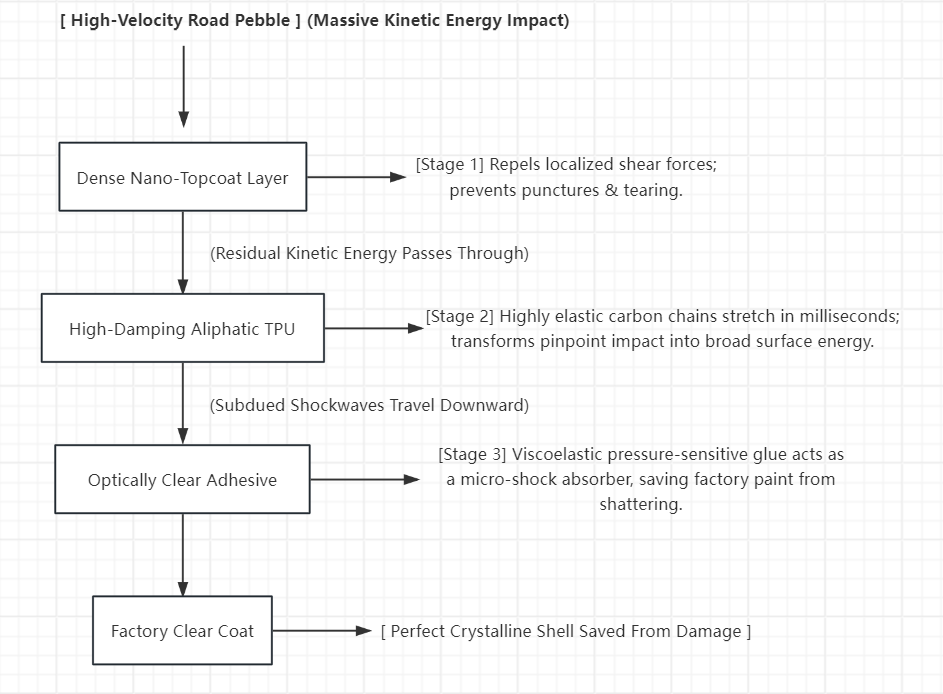
Stage 1: The Nano-Topcoat Deflection Grid (Anti-Tearing & Self-Healing)
The outermost shield of the film is a highly cross-linked, micro-thin polymer topcoat. The molecular lattice of this layer is incredibly dense, designed specifically to combat directional shear force. When a sharp gravel corner or a dry tree branch strikes the car, this slick, low-friction topcoat forces the projectile to skid off the surface rather than digging in and ripping the film. Furthermore, this layer boasts thermal shape-memory properties. If the micro-lattice is slightly compressed or scratched, exposure to ambient heat (like direct sunlight or warm wash water) triggers the molecules to re-align, autonomously closing the scratch.
Stage 2: The Aliphatic TPU Core (High-Damping Shock Absorption)
This is the workhorse of the entire network, making up over 70% of the film's total structural thickness. Elite films utilize pure, medical-grade Aliphatic Thermoplastic Polyurethane. In structural physics, this material is celebrated for its high-damping performance and extreme elastomeric tensile strength.
Instead of acting like a rigid wall—which would cause the stone to crack the material or violently ricochet—the long, saturated carbon-hydrogen chains of the Aliphatic TPU stretch and flex within a fraction of a millisecond. This hyper-elastic deformation absorbs the pinpoint kinetic energy of the flying rock and instantly spreads the load horizontally across a surface area hundreds of times larger than the initial impact zone. This effectively dilutes a paint-shattering pressure spike into a harmless, localized vibration.
Stage 3: The Viscoelastic Adhesive Foundation (Micro-Shock Wave Absorption)
The final line of defense is the advanced acrylic pressure-sensitive adhesive (PSA) that bonds the film permanently to the vehicle's clear coat. In high-performance engineering, this glue layer is much more than an adhesive; it functions as a microscopic acoustic and physical dampener.
Once the TPU core has absorbed and diluted 90% of the gravel's kinetic energy, the remaining energy moves downward as a residual shock wave. The soft, compliant structure of a premium viscoelastic adhesive dampens this final wave, preventing the brutal vibrational spike from breaking the bond between your vehicle's factory clear coat and the underlying aluminum or composite body panels. This keeps your brittle factory paint from shattering off the primer underneath.
2. The Aerodynamic Trap: Low Drag Coeffecients vs. Rock Chipping
To extract every mile of range out of a battery pack, EV engineers are obsessed with aerodynamics. Modern electric sedans and SUVs feature ultra-low drag coefficients, achieved through specific structural designs:The Design: Sweeping, low-slung hoods, eliminated front grilles, and perfectly smooth, integrated front bumpers that act like aerodynamic wedges.
The Penalty: While this design cuts through the wind beautifully, it turns the entire front fascia of your EV into a massive catcher's mitt for flying highway debris. Because the front end lacks the vertical breaks and grilles of traditional cars, there is more exposed painted surface area positioned at the exact angle to receive direct, perpendicular kinetic impacts from flying road gravel.
3. Battery Weight and Severe Ground-Level Blast
Electric vehicles are fundamentally heavier than their combustion-powered counterparts due to the massive lithium-ion or solid-state battery packs integrated into their chassis. A typical electric sedan can easily weigh 25% more than a similarly sized petrol luxury car.This elevated curb weight places immense downward pressure on the road surface. As the heavy tires roll over compromised winter roads or cracked pavement, they crush and dislodge larger chunks of aggregate.
Combined with the wide, performance-oriented tire tracks standard on most premium EVs, the lower third of the vehicle body (the rocker panels, lower door skins, and wheel arches) is placed in a permanent "blast zone." Traditional paint formulas simply lack the structural elasticity to survive this heavy-duty, high-weight environmental grinding without fracturing down to the bare aluminum or composite panels.
FAQ
Does installing PPF affect the advanced radar, LiDAR, or ultrasonic sensors on my EV?
Not if you utilize a premium, optically clear aliphatic TPU platform that does not contain metalized or disruptive layers. High-tier films engineered to the exacting quality standards of brands like Motec are radio-frequency and optically neutral. When installed by a certified professional who precisely trims around sensor apertures or applies the film seamlessly over calibrated radar housings, the film preserves 100% of your vehicle's autonomous driving and parking safety systems.
Is it true that EV factory paint is thinner than older gas-powered cars?
Yes, this is a widespread reality in modern automotive manufacturing. To meet strict global environmental regulations, many manufacturers have transitioned to water-borne paint systems and thinner clear coat applications to save weight and reduce volatile organic compound (VOC) emissions during production. This means your new EV likely has a more delicate, brittle factory shell than a car built a decade ago, making a secondary protective skin vital.
Should I get full-body coverage or just the front bumper for an electric vehicle?
While a "Partial Front" package protects the primary impact zone, EVs uniquely benefit from a "Full Body" or a customized "High-Impact" wrap. Because the high-torque rear tires throw debris along the sides of the car, and the smooth door panels are highly susceptible to aerodynamic side-swipes from road grit, wrapping the rocker panels and doors is highly recommended to maintain uniform paint integrity.
Conclusion: Future-Proofing Your Digital Machine
Driving an electric vehicle represents an investment in cutting-edge propulsion, silent luxury, and digital innovation. It is an embrace of the future. However, protecting that investment requires recognizing that the physical laws of the road have not changed—in fact, the instantaneous power of your machine has amplified them.
By encapsulating your high-performance EV in a multi-layered, energy-dissipating Aliphatic TPU defense network—aligned with the elite manufacturing and stress-resistance thresholds of brands like Motec—you future-proof its exterior. You shield the delicate, eco-friendly factory finish from the violent realities of instant-torque physics and aerodynamic vulnerability. Don't let the silent speed of the electric era slowly erode your car's visual prestige; give your machine the structural armor it needs to command the highway with absolute confidence.