

Every car owner loves the sight of rain beading up on a freshly washed vehicle. It looks deeply satisfying. However, when the storm passes and the summer sun emerges, those beautiful water droplets turn into a frustrating nightmare: Water Spots (Mineral Etching).
You wash the car, but those stubborn, chalky white rings on the hood refuse to vanish. Many owners mistakenly believe that installing Paint Protection Film (PPF) makes their car immune to these ugly spots. Let's look into the strict chemical reality: While premium PPF perfectly immunizes your factory paint underneath from mineral damage, the film's outer coating itself must fight a daily battle against water chemistry.
Here is a simple, hype-free guide to how water spots form, why cheap films fail the test, and how advanced surface-energy engineering—found in premium architectures like Motec—keeps your vehicle clear and glossy.
1. The Chemistry of a Water Spot: The Lens Effect
A water spot is not just "dirty water." When rain falls, it absorbs atmospheric dust, industrial sulfur, calcium, and magnesium minerals.
When a droplet sits on your car hood under the hot sun, a destructive two-step chemical process occurs:
[Sunlight / Heat] ──> [ Water Evaporates Completely ] ──> [ Concentrated Mineral Crust ]
↓
[Permanent Etching] <── [ High Temp (70°C) Bakes Crystals Into Surface ] <───┘
The Lens Effect: The spherical water droplet acts as a tiny magnifying glass, focusing intense solar heat directly onto the film's surface, raising local temperatures past 70°C.
The Crust Formation: As the pure water evaporates, the calcium and magnesium minerals cannot turn into vapor. They get left behind, forming a highly concentrated, alkaline mineral crust. Under extreme heat, these hard crystals literally bake and etch themselves down into the top layer of the film.
2. Hydrophobic vs. Hydrophilic: The Engineering Battle
To stop this mineral crust from baking into your car, chemical engineers design the topmost layer of the film with specific surface energy properties.
The Cheap Film Failure: Low-grade TPH or cheap PVC films have poor surface density. The water droplets "flatten out" (high wetting alignment), creating a massive surface area for minerals to bond with. When the sun hits it, the minerals easily weld directly into the soft plastic, leaving permanent, un-erasable gray rings.
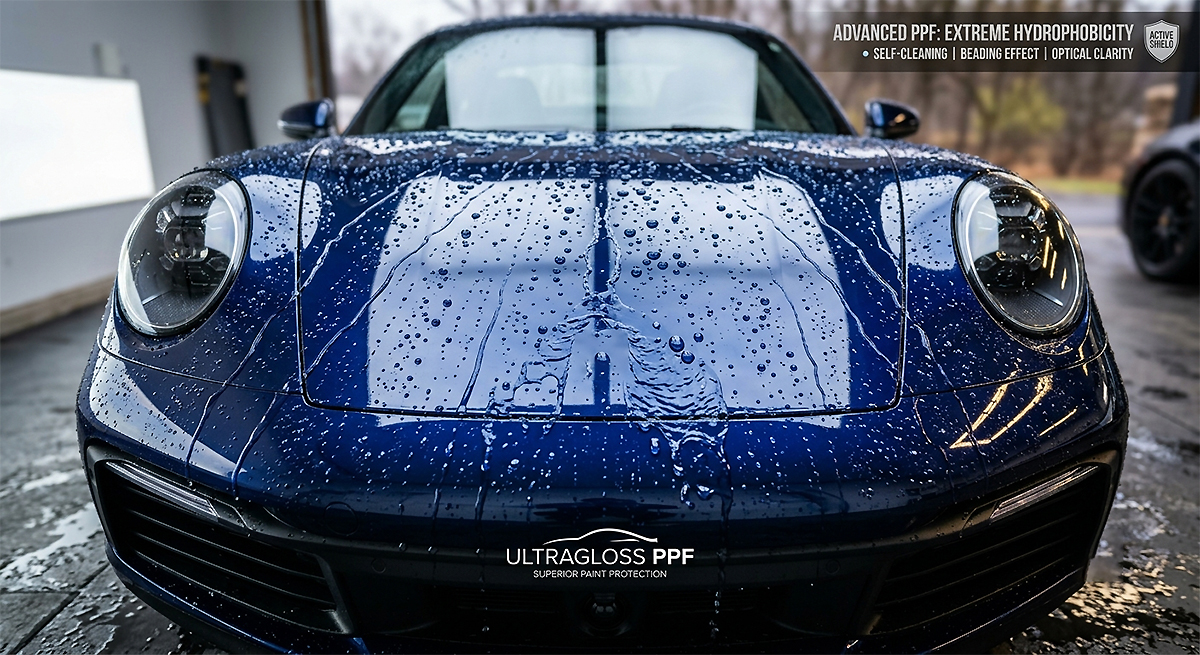
The Premium Dense Coating: Elite Aliphatic TPU systems use a highly cross-linked, high-density polymer matrix. This creates an incredibly low surface energy, making the film highly hydrophobic (water-repellent). Instead of flattening out, water is forced into tight, tall beads with minimal surface contact. When the car moves, wind resistance easily blows the beads off the panel before the sun can evaporate them.
3. Sacrificial Protection: Your Paint Remains 100% Untouched
The most critical takeaway for any car owner is the concept of Sacrificial Defense.
Even in extreme real-world environments where highly alkaline underground well water or industrial sprinkler water dries completely on the car, the mineral damage is trapped entirely within the film. The hard calcium crystals can never eat through a heavy 8mil Aliphatic TPU barrier to reach your delicate original factory clear coat.
If severe water etching occurs over several years, the film has successfully done its job—it took the permanent damage so your non-renewable factory paint didn't have to.
4. FAQ
Can the self-healing feature erase baked-in water spots?
No. Heat activates the film's "molecular memory" to heal physical scratches, but water spots are a chemical deposit problem. Adding heat to a mineral spot will actually bake the calcium deeper into the coating. To remove water spots, you need a chemical solution, such as a mild acidic water-spot remover, to dissolve the alkaline minerals.
Does parking under an underground garage sprinkler protect my car?
Paradoxically, garage sprinklers and industrial lawn water are much worse than natural rain. Natural rainwater is relatively soft, while underground well water and tap water are packed with heavy concentrations of calcium carbonate. Never let hard tap water dry on your film under the sun.
How do I keep my hydrophobic clear bra working perfectly over time?
While technical lines like Motec feature built-in, long-lasting hydrophobic topcoats, no coating remains perfectly water-repellent forever without basic maintenance. Road grime, atmospheric oil, and traffic film will eventually clog the microscopic pores of the coating. A simple wash every two weeks using a dedicated PPF sealant or coating rejuvenator will completely restore the film's slick, water-beading performance.
5. Conclusion: True Defense is a Clean Shield
A premium Aliphatic TPU film is the ultimate shield against the elements, completely bulletproofing your factory paint from permanent mineral etching. By understanding that water spots are a natural chemical byproduct of evaporation, you can skip the marketing myths. Pair a high-density, hydrophobic film with basic, smart maintenance, and your car will maintain that deep, wet-look gloss through every season.