

When car owners invest in a world-class Paint Protection Film (PPF), they usually spend weeks obsessing over material specifications. They compare tensile strength, analyze chemical formulas of Aliphatic TPU cores, and demand long-term anti-yellowing warranties.
But here is the industry’s most critical open secret: The world’s best 5-layer composite film is only as good as the technician installing it.
Without micro-precision application, a premium 8mil clear bra is nothing more than an expensive sheet of unfinished plastic. Many budget-focused detailing shops boast about "100% computerized pre-cut software with zero blades near the car" to mask their lack of technical skill. In reality, a pure pre-cut installation without manual modification leaves visible film edges that ruin the aesthetics of your vehicle and invite premature failure. Let us dive into the micro-engineering of high-end film installation and discover why edge-wrapping and micro-trimming are non-negotiable for true exterior perfection.
1. The Aerodynamic Threat to Exposed Edges
To understand why installation precision matters, you must picture your vehicle traveling down a highway at 70 MPH (112 km/h). At this speed, the vehicle's body panels are breaking through an invisible brick wall of severe atmospheric resistance and turbulent airflow.
If a clear bra is installed with standard pre-cut data that stops exactly 1 millimeter short of a panel's edge, that tiny exposed line creates a permanent aerodynamic shelf.
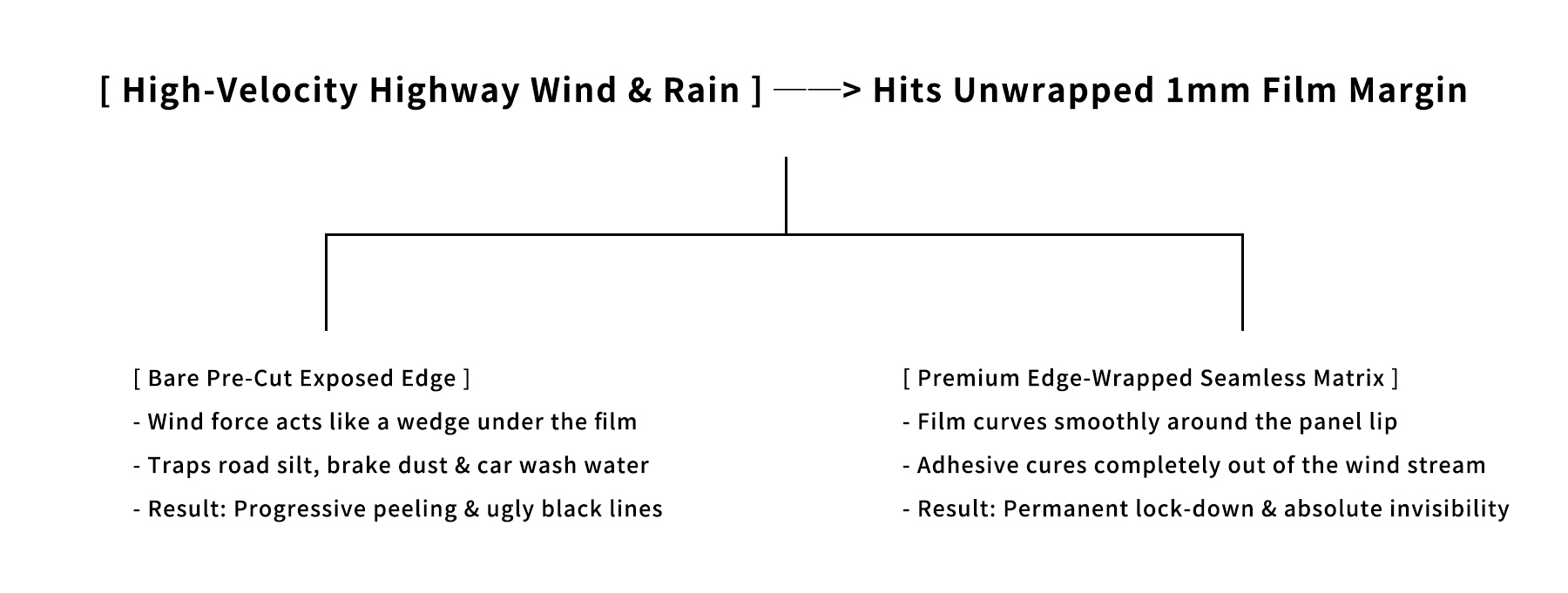
Over months of driving, the high-pressure air stream acts like a mechanical wedge, constantly trying to lift that exposed margin. Worse yet, when you take the car to a wash bay, high-pressure water jets hit that exact 1mm shelf, forcing moisture underneath the adhesive layer.
By upgrading to an advanced installation standard—matching the seamless flush execution parameters required by elite lines like Motec—technicians modify the software templates to add extended wrapping margins. The film is gently wrapped around the back lip of the hood, doors, and fenders, placing the edge entirely out of the wind stream and guaranteeing a permanent, lift-free bond.
2. The Battle for Visual Invisibility: Tucking the Corners
The ultimate test of a master PPF technician is not the flat center of a hood; it is the compound curvature of a corner where three body panels meet.
Standard automated cutting programs cannot safely calculate the exact amount of material shrinkage and stretch that occurs when an installer pulls an 8mil film over a complex bumper corner. A generic pre-cut leaves what the industry calls "relief cuts"—open triangular gaps at the corners where the bare factory paint remains exposed. These gaps act like magnets for airborne road soot and black dust, quickly creating ugly, visible dark spots on light-colored vehicles.
A master craftsman utilizes custom micro-trimming. They wrap the bulk material tightly around the complex apex of the corner, heat-shrink the polymer chains to lock the shape-memory matrix, and perform a micro-fine flush cut behind the panel seam. The result is a seamless, wrapped finish that makes the film genuinely invisible to the naked eye.
3. Tool Trimming vs. Disassembly: The Safety Protocol
One of the primary fears keeping car owners awake at night is the thought of a technician scoring their pristine factory clear coat with a utility blade during custom installation.
This fear is exactly why subpar shops rely purely on low-skill pre-cut templates. However, top-tier automotive artisans combine data-driven pre-cuts with safe, highly strategic manual trimming using advanced micro-blades.
|
Installation Element |
Low-Tier Template-Only Shop |
Premium Micro-Craftsman Protocol |
|
Edge Execution |
Film stops short of panel seams; edges completely visible. |
Software templates are manually extended; film is wrapped around lips. |
|
Corner Integrity |
Triangular relief cuts left open; traps dust and peels early. |
Seamless tuck-and-shrink technique; 100% corner paint coverage. |
|
Safety Measures |
Zero customization to avoid blade use; poor edge alignment. |
Advanced scoring techniques where the blade never touches paint. |
Furthermore, a true premium facility understands when to perform safe, minor component optimization—such as temporarily loosening clear coat emblems, side markers, or door handles. This allows the film to be laid down flawlessly underneath the hardware matrix, entirely eliminating any visible seams or cutouts around the vehicle's factory lettering.
FAQ
Does edge-wrapping void the manufacturer's film warranty?
Absolutely not, provided it is executed by a certified professional. In fact, high-end film platforms engineered to Motec parameters rely on certified installation networks because proper edge-wrapping drastically reduces warranty claims related to finger-lifting, dirt intrusion, and high-pressure wash delamination. It reinforces the product's long-term environmental durability.
How long after installation should I wait before washing my wrapped car?
You should strictly avoid washing the vehicle for at least 4 to 7 days post-install. Even though the pressure-sensitive adhesive holds firmly immediately, it requires a curing window for all residual installation moisture to completely evaporate through the semi-permeable TPU core. Blasting the vehicle with high-pressure water before the adhesive cures to its ultimate bond strength can compromise the freshly tucked edges.
Why do some wrapped corners feel slightly rough to the touch?
A properly executed wrapped corner should feel completely smooth and flush. If a corner feels sharp or rough, it means the technician failed to properly heat-shrink the film’s molecular memory matrix around the panel lip, leaving excess material Bunched up. A professional shop will easily resolve this by micro-trimming the excess relief material and locking it down with a specialized post-installation heat cycle.
Conclusion: The Masterpiece Requires the Master's Hand
In the elite world of automotive preservation, exceptional material science is only half of the equation. A world-class Paint Protection Film roll arrives at a shop as raw material; it only transforms into a bulletproof, invisible second skin through the patience and precision of a master installer.
By choosing a high-density, multi-layered Aliphatic TPU network engineered to the rigorous quality benchmarks of brands like Motec, and pairing it with a facility dedicated to artisan edge-wrapping and micro-trimming, you ensure your investment delivers its maximum aesthetic and physical return. Do not allow poor installation to compromise elite chemical engineering. Demand micro-precision craftsmanship, eliminate exposed seams, and let your vehicle enjoy absolute, invisible armor that stands up to both the highway winds and the closest inspection.