

For owners of white and light-colored vehicles, buying Paint Protection Film (PPF) is almost always driven by one major goal: keeping that crisp, factory-pure white look from turning into a dull, chalky yellow.
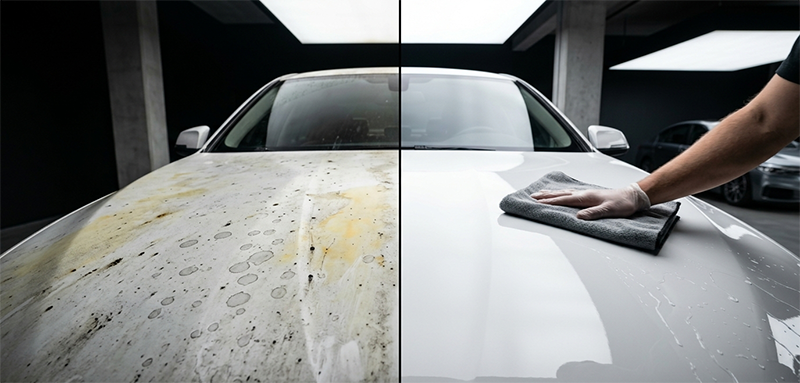
You invest in a clear bra, assuming your car is now wrapped in an armor plate. But a year later, a strange phenomenon occurs. The car hasn't been scratched, yet the film begins to look permanently dirty. Dull grey stains appear around the door handles, dark shadow streaks run down from the side mirrors, and chemical stains from asphalt or bird droppings won't wash off.
What happened? The film stopped the physical scratches, but it completely failed the test against Chemical Permeation.To protect a white car properly, you must understand the microscopic chemistry of how contaminants tunnel through low-grade wraps, and how premium high-density topcoats—engineered to the tight structural standards of lines like Motec—prevent environmental chemicals from ruining your vehicle's aesthetic.
1. The Chemistry of Permeation: Polyurethane is a Sponge
To understand why wraps stain, we have to look past what our eyes can see. To a human, a sheet of plastic film looks completely solid. To a chemical molecule, standard Thermoplastic Polyurethane (TPU) looks like a giant, loose fishing net.
Polyurethane is inherently a porous polymer matrix. It contains billions of sub-microscopic spaces between its molecular chains.
[Industrial Fallout / Tar] ──> [ Loose Polymer Chains (Cheap PPF) ] ──> [ Deep Molecular Staining ]
(Contaminants Tunnel Inside)
When oily road tar, airborne industrial soot, or acidic organic matter sits on a cheap film, it doesn't just sit on top. The molecules of these contaminants are small enough to literally tunnel into the loose spaces of the polyurethane matrix. Once these dark chemical compounds slip inside the film's core layer, they are trapped. You can wash, scrub, and polish the surface all day, but you cannot clean it because the stain is now inside the physical structure of the wrap. On a black car, this is invisible; on a white car, it ruins the vehicle instantly.
2. Setting the Record Straight: The Truth About Yellowing
Let us address a vital scientific reality that greedy marketing campaigns refuse to admit: Even the highest quality Aliphatic TPU film on earth cannot ensure a white car will never yellow over a 10-year period.
In material science, all organic polymers face inevitable oxidation when exposed to years of brutal UV radiation, intense summer heat, and atmospheric acid. However, there is a massive performance gap in the rate of this aging process:
[Premium Aliphatic TPU Matrix] ──> Straight-Chain Stability ──> Micro-Aging (Invisible for Years)
Cheap films use Aromatic structures that rot rapidly under the sun, turning white cars a disgusting shade of yellow within a year. Premium architectures utilize top-tier Aliphatic TPU. While it does age on a microscopic timeline, its straight-chain carbon chemistry resists UV breakdown so effectively that it dramatically delays the yellowing process. It stretches the degradation timeline out so far that the variance remains completely unnoticeable to the human eye for years, maintaining that clean, crisp white look.
3. The Dense Topcoat Solution: Closing the Molecular Net
If the underlying TPU core is naturally porous, how do top-tier films prevent stains and gray shadows from locking inside? The answer lies entirely in the engineering of the Topcoat.
Advanced manufacturing lines—matching the strict quality protocols seen in Motec grade configurations—infuse a highly cross-linked, high-density nano-coating onto the very top surface of the film.
(Ultra-Tight Molecular Net)
This topcoat acts as an incredibly tight molecular net. The spaces between the polymer chains are shrunk so small that contaminant molecules from road tar, acid rain, and tree sap cannot find a gap to slip through. The pollution is forced to remain strictly on the outside surface. Because it cannot penetrate the dense barrier, a simple routine car wash with standard automotive soap completely rinses the contaminants away, keeping light-colored vehicles looking pristine.
FAQ
Why do dark streaks form so quickly under my side mirrors on a white car?
Those dark streaks are caused by a mix of atmospheric road film, rainwater, and grease from the mirror assembly drying concentratedly on one specific path. On low-density or cheap films, these oily compounds easily penetrate the loose plastic pores within weeks, creating permanent grey shadows. On a high-density, hydrophobic topcoat, these oils are blocked at the surface and wash away easily during your next routine cleaning.
Can iron remover sprays damage the anti-staining layer of the film?
Harsh, highly acidic, or highly alkaline industrial chemical cleaners can slowly degrade the cross-linked structure of the topcoat over time if used repeatedly. While premium films hold excellent chemical resistance, it is always best to use pH-neutral automotive shampoos for weekly maintenance. If you must use an iron fallout remover to clean embedded brake dust, rinse it off completely within 3 to 5 minutes and never let it dry on the film under the sun.
How do I remove a stubborn bug splat that won't come off with normal soap?
Bug splatter contains aggressive organic acids that can flatten out on the surface. Instead of scrubbing hard with a rough sponge—which can physically scratch the coating—soak a soft microfiber towel in warm water (around 50 degrees Celsius) and lay it over the stain for two minutes. The heat will soften the film's memory coating and loosen the organic matter, allowing you to wipe it away completely without any structural damage to the barrier.
Conclusion: True Defense is Chemical, Not Just Physical
Protecting a white vehicle requires much more than just a thick piece of plastic to deflect flying gravel. The real enemy of a white car is the silent, daily tunneling of environmental pollution into the molecular core of the wrap.
By understanding that cheap plastics fail instantly against chemical permeation, and that high-end protection relies on pure Aliphatic TPU to drastically slow down yellowing paired with a high-density topcoat to lock out stains, you can avoid costly mistakes. Choosing an engineered system built to premium standards—like those found in Motec lines—gives your light-colored vehicle the ultimate defense it needs to stay beautifully clean, sharp, and bright on the road.