

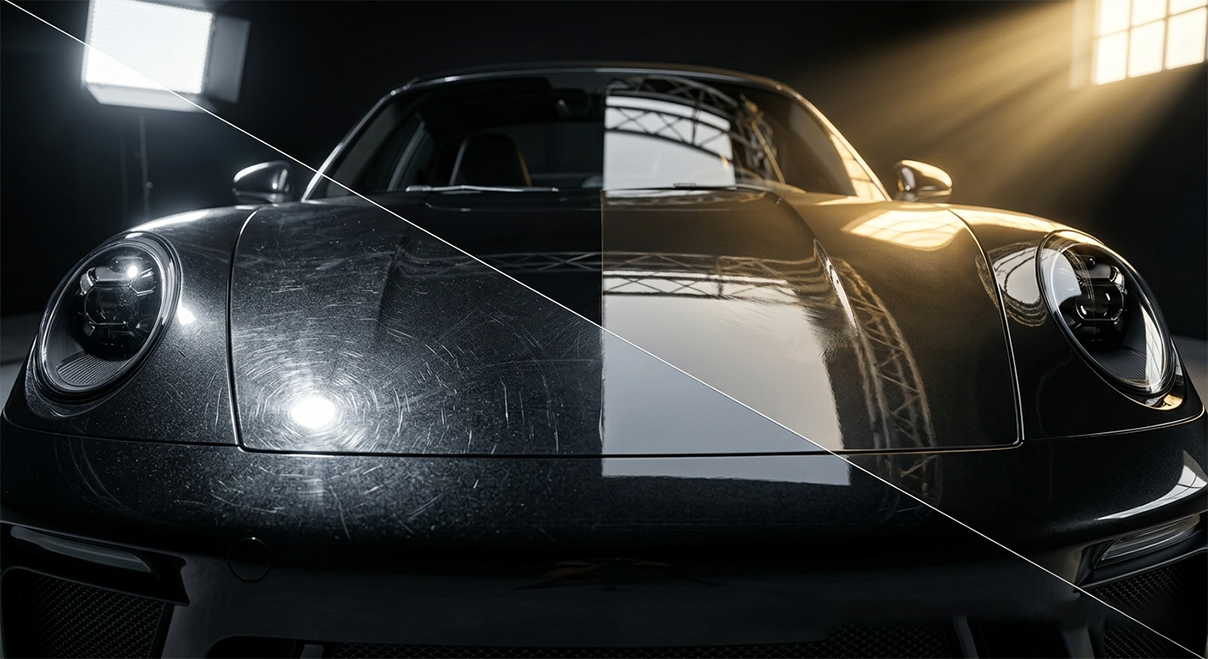
Have you ever looked at your car paint under the bright, direct glare of a gas station light or a sunny afternoon sky? If you look closely at the reflections, you will likely see hundreds of fine, circular micro-scratches spreading across the hood like a spiderweb.
In the automotive world, these are known as swirl marks or spiderweb scratches. They are the ultimate curse for anyone who loves a flawless, mirror-like gloss.
The most frustrating part? You probably caused them yourself while trying to keep the car clean. Standard micro-scratches are almost always induced during routine washing and drying. A single speck of trapped dust on a microfiber towel or a slightly stiff sponge acts like miniature sandpaper, scoring the ultra-soft factory clear coat every time you wipe the panel. Over a few years, these thousands of microscopic tracks scatter the light, turning a deep, rich paint color into a dull, hazy mess.
To break this frustrating cycle of paint degradation, modern material science has introduced a technology that feels like science fiction: Self-Healing Paint Protection Film (PPF). By looking at the elastomeric shape-memory standards engineered into premium lines like Motec, let’s explore the simple physics behind how hot water or a little sunshine can make your car scratches vanish into thin air.
1. What is "Self-Healing"? The Secret of Shape-Memory Polymers
To understand how a solid sheet of plastic can heal itself, we have to look under a microscope at the chemistry of Thermoplastic Polyurethane (TPU).Cheap plastics, like old PVC wraps, are rigid and brittle. When something scratches them, the molecular bonds are physically broken and torn apart permanently.
Premium aliphatic TPU, however, is engineered as a Shape-Memory Polymer. The outermost topcoat layer of a high-end film is composed of a dense, cross-linked network of highly elastic polyurethane chains. When a wash mitt or a stray bush rubs against this surface, the molecules aren't torn apart; they are simply pushed out of place, bending down into a microscopic trench. The film remembers its original, completely flat structural state and is just waiting for a little energy to snap back into position.
2. The Sun as Your Detailer: Thermally-Activated Recovery
This is where the magic happens. The elastic molecular network inside premium PPF requires a small thermal trigger to release its stored energy. In material science, this is known as Thermally-Activated Self-Healing.
When your car gets covered in minor wash swirls, you don't need to visit a professional detailing shop for a multi-stage machine polish. All you need to do is park your vehicle outside on a warm, sunny day.
As the sun hits the panels and raises the surface temperature of the film past its activation threshold (usually around 40°C to 50°C), the heat loosens the polyurethane chains. The bent molecules instantly regain their mobility and pull themselves back into their original, perfectly flat alignment. Within minutes, the microscopic trenches fill back up, the spiderwebs vanish, and the surface returns to a flawless, glass-like reflection—all completely automatically.
3. Immediate Results: The Boiling Water Trick
If you don't want to wait for a sunny afternoon, the self-healing mechanics can be triggered instantly using a direct heat source.Professional detailers often demonstrate this to new car owners by deliberately scratching a wrapped panel with a stiff wire brush, creating a horrific patch of dull, grey scratches. They then pour a cup of simple hot water (around 60°C) over the area.
The moment the thermal energy hits the film, the scratched patch clears up instantly, restoring a deep gloss in a fraction of a second. The same effect can be achieved using a professional heat gun or even a standard hair dryer, proving that the defensive armor is alive and actively maintaining its optical purity.
4. Say Goodbye to Paint Thinned by Machine Polishing
Before self-healing film technology became the industry standard, the only way to get rid of ugly swirl marks on a luxury car was Paint Correction (Machine Polishing).
Machine polishing involves using an orbital buffer and abrasive compounding pastes to physically shave down your factory clear coat until it matches the depth of the deepest scratch.
The massive drawback to this traditional method is that your car’s factory clear coat is extremely thin and non-renewable. You can only polish a car a few times before the clear coat becomes dangerously thin, leaving the paint vulnerable to severe UV fading and clear coat failure. By installing a premium self-healing shield—built to the uncompromising surface-resilience metrics backed by pioneers like Motec—you completely eliminate the need for abrasive polishing. The film absorbs and heals the scratches, keeping your precious factory paint thick and untouched.
5. Infinite Healing vs. Real-World Limitations
A common question among car enthusiasts is: Can a film heal itself forever, and can it heal any scratch?
- The Repetition: The cross-linked polymers in top-tier TPU are incredibly resilient. They can undergo the heat-activation and self-healing cycle hundreds of times on the same spot without losing their elastic memory, giving you long-term protection against weekly car washes.
- The Structural Limit: It is vital to understand the physical boundary of this technology. Self-healing only works on micro-scratches that affect the outermost topcoat layer. If a sharp knife, a heavy key, or a large jagged rock physically slices completely through the 8-mil polyurethane structure and tears the film apart, the molecular chain is broken and cannot pull itself back together. However, even in that extreme scenario, the film has still successfully sacrificed itself to save the original paint underneath.
FAQ
How long does it take for sunlight to heal scratches on the car?
On a warm summer day, it usually takes only a few minutes of direct sunlight for minor wash swirls to disappear completely. In colder winter months, the healing process still works, but it will take longer, or you can speed it up by pouring warm water over the panel or parking in a heated garage.
Will the self-healing properties wear out after a few years?
In low-grade TPH or cheap clear bras, the self-healing topcoat is often just a thin chemical layer sprayed on top that washes away over time. In premium aliphatic TPU films, the shape-memory mechanics are fundamentally baked into the chemical structure of the film itself, providing consistent healing performance throughout the entire warranty lifespan.
Can I scratch the film by wiping dust off a dry car?
Wiping a dusty car with a dry cloth is one of the worst things you can do to any automotive surface, as it drags sharp dirt particles across the panel. While a premium PPF will successfully heal the minor micro-marring caused by this bad habit once it gets warm, it is always recommended to use a quick detailer spray or a proper wet wash to safely lift heavy dust.
Does matte or satin PPF also have self-healing properties?
Yes! High-end matte and satin films feature the exact same aliphatic TPU shape-memory technology. They will heal everyday wash marks and micro-scratches under heat just like glossy films, ensuring your stealthy, non-reflective satin texture remains completely uniform and unblemished.
Conclusion: Lock in That "Just-Detailed" Look Forever
Owning a luxury vehicle should be an experience of pure pride, not a constant source of hyper-vigilance every time a wash mitt touches the door panel. You shouldn't have to look at your car under direct sunlight and feel a pang of regret over microscopic spiderwebs ruining the reflection.
Investing in a premium, thermally-activated self-healing PPF system—engineered to the strict material-elasticity benchmarks championed by performance icons like Motec—is the ultimate way to lock your car's appearance in stone. It gives your vehicle the incredible ability to actively reset its surface quality back to factory perfection using nothing more than the warmth of a sunny day. By letting advanced polymer engineering do the heavy lifting, you can wash your car with total peace of mind, knowing its deep, showroom gloss is completely bulletproof.